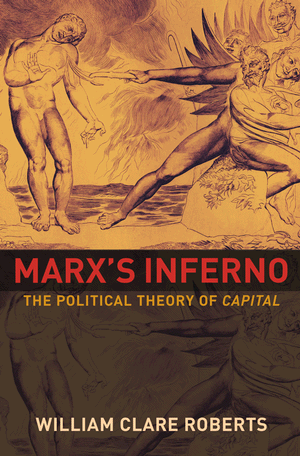
I was asked by one of my students to write a short piece for McGill Foreign Affairs Review on the question: Are ethics and the free market system irreconcilable? I thought the result was not un-worth sharing (Orwell cringes). It has just the right mix of unsubstantiated hyperbole and suggestive inscrutability.
Are ethics and the free market system irreconcilable?
Certainly not; they can be easily reconciled by the simple realization that “the free market system” is as much a figment of the imagination as are unicorns and hippogriffs. Hence, anything at all can be reconciled with “the free market system,” so long as one’s imagination is rich enough. In order to seriously consider the relationship between ethics and “the free market system,” one must get behind this fantastical construction and ask about the relationship between ethics and the real substratum of this fantasy, not to mention the relationship between ethics and the process by which this fantasy is produced. To imagine a free market system: what are the ethical stakes in such an act of fancy? I will return to this question, but first we must settle the question of where the fancy of “the free market system” comes from? What is the basis of this image in reality?
Unlike the unicorn or the hippogriff, which the imagination forms by adding together parts of real creatures to form a new whole, the imagination arrives at the free market system by subtracting something from an existent form of society. The imagined free market system is missing something essential, something without which it could not possibly be real. Having imagined this system that does not and cannot exist, we then perceive as real what we have only imagined, that is, we mistake what we actually see for our fanciful creature.
“The market” is an abstraction, but not an unhelpful one. The market is not that teeming warren of elbows and constant din where one goes on Saturday to get the best cheese for the lowest price. Rather, it is a bit of verbal shorthand for the fact that we put price-tags on lots and lots of stuff. There is a market in x if x has a price-tag on it. The market in x is a “free” market if more or less anyone in a given population can put a price-tag on x and more or less anyone can, in turn, buy x, without too much interference on either end from bureaucrats, police, or scary men in dark sunglasses and bulging jackets. Hence, a free market is always a free market in something or another: macadamia nuts, retail space, legal services. Moreover, even in this digital age when we hyperbolically pretend that space has disappeared because we can order fine Japanese teas online while sitting in our underwear in our own bedrooms, a free market is always geographically bounded, and in that sense, local. There are sites of production, sites of consumption, and avenues of transit and communication between them, all of which must be free of blockade or interference in order for the market to be free.
It has always been recognized that the existence of markets implies a very definite ethos. In order to engage in market exchange, I must recognize my partner as a free proprietor of whatever he or she brings to the exchange, having a right to possess it and a concomitant right to give it up. I must assume that he or she is attempting to get the most money or product possible in the exchange. I cannot avail myself of force or fraud. I must treat what I bring to the table as comparable with what my partner brings, such that we could arrive at a fair exchange, neither of us doing the other a favor that would impart a lasting sense of obligation. Of course, actual parties to actual market transactions might subjectively violate one or another of these strictures, but they nonetheless function as norms structuring the practice of market exchange. These norms are so far definitive of what it is to interact via the market that they constitute the recognizable character of “the good merchant”—fair, non-violent, solicitous, always on the look-out for a bargain, tolerant.
Of course, there is also the equally recognizable character of “the bad merchant”—greedy, duplicitous, money-grubbing, caring for nothing great or glorious, incapable of reverence or shame—so prominent in the popular imagination at times like now, when money managers are faking their own deaths to escape public accounting for their schemes. To some extent, this is merely the picture of someone who preserves the appearance of market ethics while violating its spirit, and to this extent it does not at all trouble the ethicality of the market, but insists upon it. The CEO who spends millions renovating his office while his underlings and customers lose their shirts is called out simply for failing to properly respect others as equal proprietors. However, the portrait of the bad merchant also contains a certain suspicion of the market ethos itself, a doubt that market ethics could ever be anything more than a minor aspect of ethics, a species of etiquette rather than ethics proper. The market must be bounded ethically as well as geographically. Some things should not be bought or sold. There are better, more important ways of interacting with others than via cash transactions. Real ethics necessarily transcends the market, since it must decide when and where the market is appropriate and when and where it is not. Thus, while the market is perfectly reconcilable with ethics, it is so reconciled only by acknowledging the limits of the market and its peculiar ethos.
The market system, however, is a different creature; it is not merely the sum of all of the free markets in the world. In order to constitute a system, markets must be linked in some self-reinforcing way. This self-reinforcing system used to be called civil society, or commercial society, or (and this is my preference) capital. So, what is the relation between capital and ethics?
Not so foreign as one might think. Ethics is just the lived experience of our relationship to our better selves. And capital pretty much has a monopoly on “better selves.” In fact, I am tempted to say that capital so completely structures our modern sense of who we are and who we should become that it is hard to conceive of any ethics other than capitalist ethics. And I just gave in to temptation. The etiquette of the merchant resembles petty-Kantianism; the other is treated as a rational actor in no need of my paternalism (in other words, buyer beware!). The ethics of capital, on the other hand, is a Pentecostal strain of utilitarianism, an enthusiastic and garrulous certainty that, whatever I do, everything will turn out for the best in the end. And the end is nigh.
To be clear, capital doesn’t tell you what you should be. That’s the beauty of it. Capital just tells you how to become whatever you think you should be. That is, it abstracts from the determinate content of the good. Wherever your treasure may lie, the ethical guidance that commercial society gives you is today what it was when Thomas Jefferson translated Destutt de Tracy’s formulation of it in 1818: “The means then of enriching ourselves is to devote ourselves to that species of labour which is most dearly paid for, whatever be its nature.” In a more modern idiom, the advice is: sell yourself. Moreover, de Tracy was up to date enough to realize that what counts is not merely the salary but also the perks. Sure, that minimum wage burger-flipping job may not seem to stack up against a partnership in corporate law, but you don’t have to mess with all that schooling, the hours are more flexible, and after the manager leaves you can pop White Snake into the boom box in back and rock out. Utility is the night in which all goods are black. The ultimate proof that all my choices have maximized my utility is that I have chosen them.
But as I said above, you can’t put the market system together with free markets and get the free market system. This is because capital implies but does not contain a third moment, a moment that makes things much messier. This moment contains the myriad processes of what Marx called “primitive accumulation”—the violent appropriation of the means of production and the baptism of this plunder that allows it to be reborn as legitimate wealth, to be bought, sold, and invested. These processes require an organized state power that does more than ensure the integrity of weights and measures. They always seem to be happening somewhere else. As John Stuart Mill happily put it, “Wars, and the destruction they cause, are now usually confined, in almost every country, to those distant and outlying possessions at which it comes into contact with savages.” But the “savages” live next door, and within each of us, also. Whatever ethics is suitable for these border wars is not easily integrated into the etiquette of the market or the ethics of salesmanship. Remembering this, or forgetting it, is what is at stake in the imaginary flight to “the free market system.”
Showing posts with label Capital. Show all posts
Showing posts with label Capital. Show all posts
Friday, February 13, 2009
Tuesday, April 22, 2008
From Beneath, It Devours
There's been a sudden resurgence in public references to Marx since Obama's "bitter" remarks. Much of it has been fueled by the perceived equivalence of Obama's claim about small-town voters and Marx's claim in the "Introduction" to his critique of Hegel's Philosophy of Right that "religion is the opium of the people." Whatever the merits of such an interpretation (they're slight, in my opinion), a recent post by publius over at Obsidian Wings (following up on this post by Mickey Kaus) has shifted the argument ever so slightly:
Any argument that produces the conclusion that the neocons are Marxists performs a reductio ad absurdum on itself. So where did this argument go wrong? I think it goes wrong as soon as it supposes that the determination of political and religious life by the economy is a Marxist position. The base/superstructure image deployed by Marx is, I would argue, taken over wholesale from the tradition of liberal political economy going back to Smith and Montesquieu.
The spread of material abundance along the vector of expanding markets is supposed to bring with it civilization, in the sense of non-violence, tolerance, and enlightened self-interest. You can find this thesis defended by Hume, by Kant, by Mill, by Constant--indeed by most every liberal since the birth of liberalism. Determination of the cultural and political superstructure by the economic base is precisely what "political economy" names.
Therefore, while there is a common thread linking Obama's comments (at least as they were received) and Bush's war strategy, it is the common thread of liberal political economy.
Marx's relation to this tradition is complicated (see the post below re: Malthus), but I don't want to deny that there is a powerful strand of Marxism that is consistent with political economy. Kaus mentions vulgar Marxism, and I'd be happy to pin this label on economic Marxism. Economic Marxism draws different lessons from the premise it shares with economic liberalism, but it does share this premise.
Nonetheless, Marx sub-titled Capital "A Critique of political Economy," and there is an equally robust strand of Marxism that takes of this anti-economistic challenge. I would note at least three important theses that differentiate this Marxism from the base-determines-superstructure model of political economy:
To clarify, whatever Obama intended to say, the resulting debate has turned — as Kaus says — Marxist. The debate has evolved into a discussion of whether the cultural preferences of bitter Pennsylvanians stem from a lack of economic opportunity. To put the question in more stark Marxist terms — are Pennsylvanians’ cultural preferences (i.e., the superstructure) determined by economics? If so, then those cultural preferences will presumably shift if people become more economically secure.Publius goes on to argue that the same logic underlies the Bushies' war on Iraq: "the neocon vision shares some Marxist assumptions. Specifically, it too sees religion and radicalism as superstructure. Change what lies beneath and you’ll change what rests on top, or so the theory goes."
Any argument that produces the conclusion that the neocons are Marxists performs a reductio ad absurdum on itself. So where did this argument go wrong? I think it goes wrong as soon as it supposes that the determination of political and religious life by the economy is a Marxist position. The base/superstructure image deployed by Marx is, I would argue, taken over wholesale from the tradition of liberal political economy going back to Smith and Montesquieu.
The spread of material abundance along the vector of expanding markets is supposed to bring with it civilization, in the sense of non-violence, tolerance, and enlightened self-interest. You can find this thesis defended by Hume, by Kant, by Mill, by Constant--indeed by most every liberal since the birth of liberalism. Determination of the cultural and political superstructure by the economic base is precisely what "political economy" names.
Therefore, while there is a common thread linking Obama's comments (at least as they were received) and Bush's war strategy, it is the common thread of liberal political economy.
Marx's relation to this tradition is complicated (see the post below re: Malthus), but I don't want to deny that there is a powerful strand of Marxism that is consistent with political economy. Kaus mentions vulgar Marxism, and I'd be happy to pin this label on economic Marxism. Economic Marxism draws different lessons from the premise it shares with economic liberalism, but it does share this premise.
Nonetheless, Marx sub-titled Capital "A Critique of political Economy," and there is an equally robust strand of Marxism that takes of this anti-economistic challenge. I would note at least three important theses that differentiate this Marxism from the base-determines-superstructure model of political economy:
- The mode of production is not reducible to a mode of distribution. That is, the way we produce is prior to the economic questions focused on by political economy.
- The mode of production of capitalism is fundamentally revolutionary and disruptive. That is, the "base" is not a stable foundation upon which economic, political, and cultural institutions might arise. Rather, the mode of production constantly undermines and subsumes whatever seems to aspire to an external or independent existence. From beneath, it devours.
- The mode of production does not explain itself, but was brought into being and is continually maintained by extra-economic violence, what Marx calls "primitive accumulation." (On which, see this excellent review of There Will Be Blood by Unemployed Negativity.)


Tuesday, February 19, 2008
What does honesty mean?
In their story about the Hallmark Packing Plant in California, the Washington Post quotes the incredulity of management:
Still, what bothers me about the coverage of this admittedly disgusting episode is the way in which two factors are consistently left out of the frame:
In an interview, Mendell expressed disbelief that employees used stun guns to get sick or injured animals on their feet for inspection.
"That's impossible," he said, adding that "electrical prods are not allowed on the property."
Asked whether his employees use fork lifts to get moribund animals off the ground, he said: "I can't imagine that."
Asked whether water was sprayed up animals' noses to get them to stand up, he said: "That's absolutely not true."
"We have a massive humane treatment program here that we follow to the nth degree, so this doesn't even sound possible," Mendell said. "I don't stand out there all day, but to me it would be next to impossible."
Now it goes without saying that this schlump is lying repeatedly and obviously. To be confronted with video evidence and then to say that what the video shows is impossible takes gumption (or desperation).
Still, what bothers me about the coverage of this admittedly disgusting episode is the way in which two factors are consistently left out of the frame:
- The media scrutiny is focused on the employees--those shown in the video and managers like Mr. Mendell. Now, I have no great love for managers, but they are, ultimately, just mediators. They are paid to do what is necessary to please the people with the capital. How would the stockholders respond to the video? Why was it shown to the manager, but not to the owners? Aren't the owners responsible for what happens on their property and at their behest? (This is not to excuse the fork-lift operators, the line bosses, or Mr. Mendell, but shouldn't the accounting be a bit wider, and trace things back to the first cause?)
- Also, there is this ridiculous statement included in the story, made by the president of the Humane Society: "To sneak downers past inspectors, Pacelle said, is 'penny-wise and pound-foolish.'" As rhetoric aimed at the owners of meat-packing operations, that's all well and good, I suppose, but the problem here is not one of fiscal irresponsibility!! The future that is destroyed by the factory-farm system is not reducible to future returns on our investments.
Subscribe to:
Posts (Atom)