Monday, February 7, 2022

On Lukács's construction of class consciousness


I did not write the following text with public presentation in mind – it was merely an exercise in trying to clarify for myself Lukács's arguments regarding class consciousness. However, since there have been a few requests on Twitter for me to explain at greater length some of my many objections to Lukács's
History and Class Consciousness, I thought it might be worthwhile to make this available for those who are interested.


Because it originated as reading notes, what follows basically marches through the "Class Consciousness" essay from beginning to end. I do not, except right at the end, bring in anything from Lukács's other essays. I wanted only to make as clear as possible how the essay's argument unfolds. When I copy/pasted this into the blog editor, I lost all the footnotes – and hence all of the page citations – and all of the diacritical marks. I added a few of each back in (notes are at the end) but it was too tedious, so I gave up. Apologies for that! All quotations come from the standard Livingstone translation, but I have sometimes modified them.


---


Lukács begins from Engels, but interprets Engels in a particular way. Engels makes two claims about historical materialism: that individual motives may spur individual action, but that they do little to determine collective outcomes; and that preceding historical causes drive the formation of individual motives. Lukács transmutes these claims into “the essence of scientific Marxism”: “the realization that the real motor forces of history are independent of man’s (psychological) consciousness of them.” 


He also takes Marx’s remark, from Capital, that reflection on human forms of life “begins post festum” to be specifically about “bourgeois thought.” Rather than a general claim about human beings acting first and seeking to understand afterwards, it becomes a specific claim about bourgeois “dogma.” On this basis, he diagnoses a “dilemma” in bourgeois thought: either the social institutions of the bourgeois epoch become “fossilized” as the eternal form of society itself, or else “everything meaningful and purposive is banished from history,” which becomes a senseless series of fatalities. 


Lukács maintains that Marx has exposed this dilemma “as an illusion” cast by “man’s plight in bourgeois society,” wherein people are “at the mercy of the forces of production.” Marx reduces “the objectivity of the social institutions so hostile to people to relations between people,” and this is supposed by Lukács to “overcome the objectivity attributed both to social institutions inimical to man and to their historical evolution,” an overcoming which results in “the restoration of this objectivity to their underlying basis, to the relations between people.” “This objectivity,” Lukacs claims, is thereby revealed to be “the self-objectification of human society at a particular stage in its development.” 


This is all incredibly unhelpful. It only brings Lukacs back to where he began. “Dialectical materialism,” he claims, “does not deny that people perform their historical deeds themselves and that they do so consciously. But, as Engels emphasizes in a letter to Mehring, this consciousness is false.” 


This is not what Engels wrote to Mehring, however. Engels’s claim was much more limited. He wrote:


Ideology is a process accomplished by the so-called thinker consciously, indeed, but with a false consciousness. The real motives impelling him remain unknown to him, otherwise it would not be an ideological process at all. Hence he imagines false or apparent motives. Because it is a process of thought he derives both its form and its content from pure thought, either his own or that of his predecessors. He works with mere thought material which he accepts without examination as the product of thought, he does not investigate further for a more remote process independent of thought; indeed its origin seems obvious to him, because as all action is produced through the medium of thought it also appears to him to be ultimately based upon thought.


Engels is not discussing people in general, but ideologists in particular. As he continues in the next paragraph:


If Luther and Calvin “overcome” the official Catholic religion, or Hegel “overcomes” Fichte and Kant, or if the constitutional Montesquieu is indirectly “overcome” by Rousseau with his “Social Contract,” each of these events remains within the sphere of theology, philosophy or political science, represents a stage in the history of these particular spheres of thought and never passes outside the sphere of thought. And since the bourgeois illusion of the eternity and the finality of capitalist production has been added as well, even the victory of the physiocrats and Adam Smith over the mercantilists is accounted as a sheer victory of thought; not as the reflection in thought of changed economic facts but as the finally achieved correct understanding of actual conditions subsisting always and everywhere – in fact if Richard Coeur-de-Lion and Philip Augustus had introduced free trade instead of getting mixed up in the crusades we should have been spared five hundred years of misery and stupidity.


Engels is discussing the peculiar idealism that sees the movement of history as an ongoing argument in which certain intellectual developments supplant older forms of thought by winning ‘the battle of ideas.’ Engels’s point is twofold. The active life of doing and making both precedes the intellectual life of understanding and constructing arguments and this active life is the effective force behind changes in the realm of ideas. Practice precedes theory and drives theory; theory does not precede or drive practice. 


Lukacs turns these claims about theoretical systems into claims about consciousness as such. For Lukacs, action precedes and impels consciousness, and is misrecognized by the consciousness that accompanies it from behind, as it were. The historical objectivity of previous results – themselves unintended outcomes – impels us to act without any awareness of this real motive power. Thrown into the future by the accumulated force of the past, we act without knowing why we act. 


Lukacs, in essence, substitutes “history” for “ideology” in Engels’s claim. In Lukacs’s rewriting, history is a process accomplished by the so-called historical agent consciously, indeed, but with a false consciousness. The real motives impelling him remain unknown to him, otherwise it would not be an historical process at all. Hence he imagines false or apparent motives. 


This substitution of history for ideology leads up to Lukacs’s famous “twofold dialectical definition of ‘false consciousness’” and to his definition of class consciousness as “imputed” [zugerechnet] consciousness. Lukacs drives a wedge between “concrete investigation” of false consciousness and the examination of “the empirical individual” – be it “man, class, or people” – in order to discern the “empirically given (and hence psychological or mass-psychological) consciousness.” According to Lukacs, “concrete investigation” can only be carried out as an investigation in “relation to society as a whole.” 


Only when this relationship to the whole is kept in mind does the “dialectical definition” of false consciousness appear. The individual historical agent has a certain “subjectively justified” consciousness, a consciousness that is understandable as a response to the social situation in which agents find themselves. Nonetheless, this subjectively justified consciousness is partial, limited, and, to that extent, objectively false. The historical agent cannot see the whole picture, and strives, therefore, for something it cannot achieve. Because of its objective falseness, this consciousness is not able to obtain its subjective aims, but – and this is where Lukacs pulls the rabbit out of the hat – what it does achieve are “the objective goals of social development, which it does not know and did not will.”


This result depends upon rechristening the unintended outcome of intentional action as the intended outcome of the social totality’s action, the realization of history’s goal by the unwitting agency of individual people, classes, and nations. But this determination of, as it were, the total social consciousness does not yet give us class consciousness, which is supposed to be the object of this investigation. Class consciousness is discerned by moving back one step from the totality, by “infer[ing] the thoughts and feelings which people would have in a particular situation if they were able to assess both it and the interests arising from it in their impact upon immediate action and on the whole structure of society.” This counterfactual consciousness – the rational assessment and aims “appropriate to their objective situation” – gives us the form of imputed consciousness in general. Class consciousness proper comprises “the rationally appropriate reactions imputed to a particular typical position in the process of production.” 


The first three moments of the dialectical definition of false consciousness gave us something intelligible: individuals acting on a partial understanding of the social whole and thereby achieving unintended results. Similarly here, Lukacs has so far given us something counterfactual but theoretically reasonable: a reconstruction of the consciousness that would be rational for a class-positioned agent with full information. But now he seems to pull another rabbit out of the hat, concluding that “the historically significant actions of the class as a whole are determined in the last resort by this consciousness and not by the thought of the individual.”


Now, this might be salvageable in a way that the goal of social development is not. It may be that the irrational and inappropriate actions of class-located individuals amount to nothing, precisely because they are irrational and inappropriate. The rationally appropriate course of action for an individual capitalist is to pump as much surplus labor out of their workforce as possible. Any capitalist who is soft-hearted or soft-brained enough to slack up on the exploitation will lose market share and profitability to competitors who act in the rationally appropriate manner. Thus, the social action of the capitalist class as a whole will approximate to the rationally appropriate policy. 


This result depends, however, on the operation of selection mechanisms like competitive markets. Do all class actors face analogous, clearly-defined collective action scenarios with dominant strategies?


No. And Lukacs admits as much. The section that follows his definition of (imputed) class consciousness details the failure of this model to generalize. “For pre-capitalist epochs and for the behavior of many strata within capitalism whose economic roots lie in pre-capitalism,” he begins, “class consciousness is unable to achieve complete clarity.” But this is the thin edge of the wedge. It is not just that the class consciousness of estates and castes is muddled by the “political and religious factors” that mediate their relationship to the economic basis of their existence. “There is,” in fact, “no possible position” within a pre-capitalist society “from which the economic basis of all social relations could be made conscious.* 


This veil between “the vantage point of a particular class” and “the totality of existing society,” a veil that precludes the formation of an actual class consciousness, does not afflict only pre-capitalist classes. Even within capitalist society itself, most classes are so situated that their vantage point “is ambiguous or sterile.” In the cases of the modern peasantry and petit bourgeoisie, “we cannot really speak of class consciousness,” since “a full consciousness of their situation would reveal to them the hopelessness of their particular striving.” That is, there is no rationally appropriate and fully informed strategy in their situation. Only two classes, the bourgeoisie and the proletariat, are “pure classes,” capable of forming a real class consciousness. “Only from the vantage point of these classes,” Lukacs writes, “can a plan for the total organization of society even be imagined.” We can see here just how strongly Lukacs is attached to the notion of social totality (the complete information proviso in my reconstruction of his definition above). 


This attachment creates a paradox, however. Already we have seen that the causal force of class consciousness depends upon the operation of a selection mechanism that excludes all pre-modern classes from the set of class conscious historical agents. The totality condition has whittled this down further, leaving only the bourgeoisie and the proletariat. But it actually has ramifications beyond this. When the totality condition is combined with the selection mechanism, the bourgeoisie ends up in an impossible position. The bourgeoisie has a rationally appropriate strategy – maximize exploitation in order to maximize profits – that can be causally effective in determining the actions of individual members of the class, but this strategy is incompatible with complete information (or a infinitely reiterated game scenario), under which condition it turns into an irrational strategy. In Lukács’s terms, the class consciousness of the bourgeoisie “is cursed by its very nature with the tragic fate of developing an insoluble contradiction at the very zenith of its powers.”


Lukacs is himself very unclear on this point, and may not have understood the implications of his own argument here. The most plausible reconstruction is the most straightforward one: the bourgeoisie, in pursuing the rationally dominant strategy of maximizing profits, immiserates the working class and renders it incapable either of purchasing the products of its own labor (a demand-side theory of crises) or of reproducing its own labor-power (a supply-side theory of crises). In the words of the Manifesto, the bourgeoisie is “incompetent to assure an existence to its slave within his slavery, because it cannot help letting him sink into such a state that it has to feed him, instead of being fed by him.” 


Lukacs adorns this conclusion with fancy dress, calling it a “dialectical” antagonism within bourgeois consciousness rather than a “contradictory” one, but the plain conclusion is that the bourgeoisie cannot possess a real class consciousness, either.** The position of the bourgeoisie in production is such that “if they were able to assess both [their situation] and the interests arising from it in their impact upon immediate action and on the whole structure of society,” they would not be able to find any rational strategy to pursue. The strategy that seems rational in guiding their immediate action is fatal in its ramifications on the whole structure of society. The bourgeoisie can have a class consciousness only in the form of a “‘false’ consciousness.”*** 


Thus, Lukacs is driven to the conclusion that only one class in the history of humanity is capable of possessing class consciousness: the proletariat. 


But then he is caught on the other side of the paradox that undid bourgeois class consciousness. The same selection mechanism that ensures bourgeois false consciousness prevails over the idiosyncratic motives of individual capitalists – the operations of market competition in the exchange of commodities – works against the determination of proletarian action by class consciousness. 


The situation of the individual proletarian – or individual group of proletarians – exerts selective pressure to prioritize achievable local goals, such as better pay and better job security, over long-term and highly risky strategies like mobilizing for revolution. Lukacs knows this. He highlights it. He locates “in the center of proletarian class consciousness … and antagonism [Widerspruch] between momentary interest and ultimate goal.” But this just leads him to double down: “class consciousness is identical with neither the psychological consciousness of individual members of the proletariat, nor with the (mass-psychological) consciousness of the proletariat as a whole; but it is, on the contrary, the sense, become conscious, of the historical role of the class.” In other words, the rationally appropriate strategy for anyone located in the class position of the proletariat is to recognize the long-term untenability of reforms to capitalism and to embrace revolutionary socialism. 


But this is too convenient by half. Lukacs is simply presupposing that his theoretical construction of class consciousness – which assumes that one’s position in the process of production is the only aspect of one’s situation that gives rise to rationally appropriate strategies – is not only a) present to individual proletarians as an available psychological consciousness but also b) that the the analysis of the false consciousness endemic to all the other classes is both i) available to individual proletarians and ii) basically descriptive of the actual strategies pursued by those other classes, such that iii) proletarians can recognize it as the strategy being pursued. In other words, the rationally appropriate strategies (even when these are self-contradictory and hence not rational) are the actual strategies being pursued, and this fact is available to regular empirical consciousness. 


This reveals two insuperable problems with Lukacs’s theory. 


First, he has to, in the case of the proletariat, violate his own strictures about keeping imputed class consciousness separate from empirical-psychological consciousness. He argues that “every momentary interest” of the proletariat is ambiguous – “either it will be a step towards the ultimate goal or it will conceal it” – and that what decides the matter is only “the class consciousness of the proletariat.” But this only makes any sense if class consciousness has here come to mean the mass-psychological consciousness of empirically identified proletarians. The success of the proletarian revolutionary movement depends entirely upon “the ideological maturity of the proletariat, i.e., on its class consciousness,” which can only mean on the psychological uptake of class consciousness. 


Thus, class consciousness as an imputed rationally appropriate strategy is impossible for all non-proletarian classes – since they cannot pursue a rational strategy given their social situation – but also impossible for the proletariat, since “the historically significant actions of the class as a whole are,” it turns out, not “determined in the last resort by this consciousness” in contrast to “the thought of the individual,” but only by the becoming individual of this consciousness. The proletariat makes the whole world, and will make the whole world consciously just to the extent that individual proletarians become psychologically conscious of belonging to the class that makes the whole world. 


Second, therefore, Lukacs’s construction of class consciousness reduces to a pure moralism. The imputed proletarian class consciousness is simply the capacity to rationally plan the totality of human society. This consciousness belongs to the proletariat because their situation in production is that they make the entire concrete world, the world of use-values, and are therefore able “to see society from the center, as a coherent whole.” As they become psychologically conscious of this class consciousness, they form “revolutionary workers’ councils,” which embody “the economic an political defeat of reification,” since they tend to abolish all separations: “the bourgeois separation fo the legislature, administration, and judiciary,” as well as “the fragmentation of the proletariat in time and space” and the separation between “economics and politics.” In short, the real proletarians, as soon as they are really conscious of being proletarian, will act in a really proletarian manner to consciously and methodically create the totality of society as a unity – and thereby also to cancel their existence as proletarians by eliminating classes altogether. 

This is pure moralism because it posits a form of consciousness that sees all, knows all, and acts only and always for the sake of humanity as a whole, and claims that the effectiveness of this consciousness “can only come about as the product of the – free – action of the proletariat itself.” That the proletariat is capable of the conscious and unified creation of the social totality – the total planning of society – is simply a matter to be taken on faith. Any failure to rationally produce this planned society is a failure to achieve the self-canceling proletarian class consciousness. To ask how this consciousness proceeds to determine its acts is to admit that one does not possess this consciousness.


* HCC, 55-7. This is, in fact, a very interesting conclusion with far reaching implications. In many respects it foreshadows the arguments regarding the “moral economy” of the peasantry that emerged from New Left studies, including those of E.P. Thompson, Ranajit Guha, and James Scott. As Thompson put it at one point, “the contest for symbolic authority [between plebians and gentry] may be seen, not as a way of acting out ulterion ‘real’ contests, but as a real contest in its own right” (“Eighteenth-Century English Society: Class Struggle without Class,” Social History 3:2 [May 1978]: 159). The point is that in pre-capitalist conditions of production, it is not rationally appropriate for any class to ‘play the game’ – production, exploitation, and resistance to exploitation – economically. Under pre-capitalist (or incompletely capitalist) conditions, forms of economic ‘irrationality’ – cultures of prestige, traditional limits on production, ‘natural’ price-setting, etc. – are themselves rational.

** The standard English translation is hopeless here. Lukács contrasts a dialektischer Widerspruch to a kontradiktorischer Widerspruch, but Livingstone often translates Widerspruch as “contradiction,” muddying the waters.

***HCC, 65. Thus, further down the same page, Lukács observes that, while the bourgeoisie is driven “to clarify its own class interest on every particular issue,” this “clear awareness” – class consciousness itself – “becomes fatal when it is extended to the question of the totality.”

Wednesday, November 17, 2021

Productivity and Science in Marx: A Response to John Ganz

Let’s talk about science and the productive forces in Marx!

John Ganz provoked everyone a couple weeks back by tweeting, first, that Marx teaches us that “socialism and eventually communism is not supposed to be a more moral system, but such an abundantly more productive system that the moral issues that arise in capitalism no longer exist.” He followed that up with another banger: “people want marx to be the cool humanist political writer who references shakespeare etc. and ignore the cringe 19th century parts where he's like ‘this is actually all science,’ but they are both there,” adding that “taking the deterministic parts [of Marx] seriously is kind of more interesting, even if it creates big problems.” After merrily engaging in the pugilism for a while, he wrote up his argument in essay form on his Substack. 

I love some good Marxology, so I want to evaluate Ganz’s interpretive arguments. But I also want to say something about why these questions of science and productivity are politically important. In fact, I think two of the most important lessons we can take from Marx for contemporary emancipatory politics are embedded in these questions. So kudos to John for putting his finger on both of them – even if I am going to disagree with him about a number of issues. But also, the question of how best to relate to the thought of 19th century socialists like Marx is a motivating one for Ganz, and for me as well. 

I’ll take the issues in the same order they came up: production first, science second.

Let’s establish some common ground first. Marx repeatedly and consistently maintains – and Ganz cites some of these passages in his essay – that the relations of production allow for the development of the forces of production, but that, as these forces of production develop, they come into conflict with the relations that have till then fostered them. At this point, the relations of production become fetters on the forces of production. This fettering continues until a social revolution transforms the relations of production into new relations, which can be forces- developing at this higher stage. Since socialism or communism is the highest stage of human development, and supercedes capitalism, it follows immediately that socialism must, according to Marx, have more developed forces of production than capitalism does. This is Hist-Mat 101. 

The disagreements start as soon as we ask: what the hell does all of that mean? I study and teach Marx professionally and I will be the first to admit that Hist-Mat 101 sounds like a heaping bowl of word salad. Can we say the same things in a way that specifies the forces and relations of production, development, and fettering such that it sounds like anything other than a series of formulae? 

Ganz implies that Hist-Mat 101 means that the sufficiently-developed productive powers of labor cause – that is, are necessary and sufficient conditions for the coming into being of – socialism. That’s how I understood his first missive. If socialism is so much more productive that the moral issues that arise in capitalism don’t come up, it seems that the increase in productive powers is what brings socialism about – otherwise the moral issues about how to distribute scarce goods would still be coming up under socialism. This is also why Ganz later insists that Marx is a determinist about history: the development of the productive powers of humanity follows a causally determinate and causally determining path, and social, political, and moral issues tag along for the ride but do no independent work.

This is a respectable interpretation of Hist-Mat 101, with a long lineage. One of its greatest proponents was the young G.A. Cohen. His 1978 book, Karl Marx’s Theory of History: A Defense, explicitly set out do give to the COMINTERN Marxism Cohen grew up with the most rigorous statement possible. I think it is fair to look to KMTH, therefore, to see the very best version of the argument Ganz is making.

According to Cohen’s version of Hist-Mat, the underlying trajectory of human history is the expansion of the productive power of humanity. Despite all local and temporary setbacks, there is a tendency for the forces of production to grow or develop. Since the productive forces produce use-values, of which there is no common measure, the development of the productive forces must be measured by “the amount of the day which remains after the laboring time necessary to maintain the producers has been subtracted” (Cohen, 2000, p. 61). The core of Hist-Mat, then, is this historical growth of our power to produce surplus time. 

But Hist-Mat is scientific because it is explanatory: the core claim is supposed to explain the form taken by the dominant relations of production or by the economic structure of society. Economic structures that allow or encourage this development in natural power win out over those economic structures that hamper this development. Hence, any socialist economic structure must be better able to produce surplus time than is capitalism. Hence, also, social revolutions can be premature, when the forces of production are not developed enough to support the relations of production introduced by the revolutionaries. In Cohen’s terms, social or economic power is functional for productive power, and takes the form that is compatible with the current level of development of productive power.

Except, that is, when it is not and does not.  

For it is also true that, as Cohen puts it, “the production relations are capable of fettering, that is, restricting the use and development of the productive forces” (2000, p. 41). During any period of time when fettering is occurring, “Dysfunctional relations persist” (p. 161). This dysfunctional state of affairs poses a significant difficulty for the Cohen/Ganz construal of historical materialism. 

During periods of fettering, the relations of production are not explained by their functionality for the forces of production on hand, since they are dysfunctional given those forces. Hence, during periods of fettering the perseverance of the economic structure, if it is to be explained at all, must be explained by something other than the material powers. 

Cohen thought the US was in a period of fettering in the late-1970s. According to Ganz, Marx thought that “the social organization of capitalism, with its class relations, was holding back or ‘fettering’ productive power” – and presumably this means in the England of the 1860s. That’s a lot of fettering! 

It seem that, according to Hist-Mat 101, fettering has been happening in the capitalist core for 150 years. The productive powers we have are incompatible with the economic structure we have, and call for a new economic structure, and yet the old economic structure persists. The moral issues that arise in capitalism shouldn’t be coming up now, and shouldn’t have been coming up for a while. The functional explanation of social power by natural power – the fundamental theorem of Hist-Mat 101’s social physics – is unable to explain anything that has happened in the capitalist core since Hist-Mat 101 was formulated. That seems bad.

So maybe Marx and Cohen were both wrong, and fettering isn’t happening yet. Maybe the forces of production still have to develop for a while under capitalism before they will be sufficiently mighty to burst the constraints of the capitalist relations of production. Maybe?

Yeah, maybe. But the basic problem with the causal reading of Hist-Mat as a reading of what Marx was up to is that it makes politics apparently superfluous, and yet eighty percent of what Marx did in his life and in his writing was engage in politics and encourage the workers’ movement to engage in politics. In other words, if productive-forces causality is the right way to read Marx, then the consequence is not only that Marx was very wrong about the state of development of those productive forces, but also that he was fundamentally confused about his own argument, since he ought to have drawn the lesson that political struggle is epiphenomenal to the progress of the productive powers of labour. 

Rather than taking the development of the forces of production as causal, though, Marx seems to have taken this development as motivational. That is, the growing productive powers of cooperative and large-scale labour motivate the working class to organize themselves and to struggle for socialism, not because these powers make the moral issues that arise from capitalism – the question of how to distribute the needs of life – irrelevant, but because these powers make these questions more and more pressing. Or, to expropriate a phrase from Rosa Luxemburg, the development of the powers of production is indispensable to socialism, not because it renders superfluous the political tasks of socialism, but because it renders these political tasks both necessary and possible. 

The political tasks are necessary because the crises caused and threatened by these massive productive powers are increasingly existential. The political tasks are possible because the workers are increasingly aware of the scope of the problems and are increasingly able to communicate and organize with one another. If Marx was too optimistic about anything, it was not that humanity was on the cusp of an age of superabundance in which we wouldn’t have to fight over scarce resources any more, but that the working class was on the cusp of solving the collective action problems presented by the market economy through concerted, international, and solidaristic action. 

There is another side to Ganz’s claims, though. He also argues that Marx thought socialism (and then communism) would cause a huge increase in productive powers, such that socialism would be “abundantly more productive than capitalism.” This was already implied, of course, in the notion of fettering, but it can also stand independently. Even if Marx did not think the growth of productive powers causes socialism, he might still have thought that socialism would cause such a massive increase in productive powers that everyone’s desires could be met without anyone ever having to weigh the tradeoffs or make hard decisions about whose desires ought to be satisfied. In the parlance of the internet, did Marx believe in fully automated luxury communism? 

Let’s tackle the passage Ganz cites from Marx’s “Critique of the Gotha Programme,” since this is not some explosion of youthful enthusiasm, but the argument of a man who had already written Capital. Marx there writes:

In a higher phase of communist society, after the enslaving subordination of the individual to the division of labor, and therewith also the antithesis between mental and physical labor, has vanished; after labor has become not only a means of life but life's prime want; after the productive forces have also increased with the all-around development of the individual, and all the springs of co-operative wealth flow more abundantly – only then can the narrow horizon of bourgeois right be crossed in its entirety and society inscribe on its banners: From each according to his ability, to each according to his needs!

This is certainly Marx at his most utopian, and he seems to express here a sort of cornucopianism. And yet, what has always stood out to me about this passage is that Marx is postponing the cornucopia to a distant time. What Louis Blanc wanted to institute immediately – from each according to his ability, to each according to his need – Marx is claiming could only become a reality after the division of mental and physical labour is overcome, after labour has become a thoroughly pleasurable activity, and after everyone has become capable of all manner of cooperative scientific work. 

Far from being something that would be unlocked by the socialist revolution, this is a possibility that Marx kicks far down the road in order to emphasize, instead, how much work socialists will have to do to solve the tricky distributional questions that will arise immediately from a socialist economy. Fully automated luxury communism, if it is a possibility at all, is not an immediate possibility, suppressed by the social organization of capitalism. 

On the question of science, finally, Ganz argues that “Marx viewed his own thought on analogy to or even an extension of the natural sciences.” These are two very different things, though. Ganz is on stronger ground when he emphasizes the analogies Marx draws between his own thought and the natural sciences. There is simply no doubting that. Like Hist-Mat 101, though, there is a question of what those analogies mean. Do they imply that Marx’s approach to history is positivistic or deterministic? 

Short answer: no. 

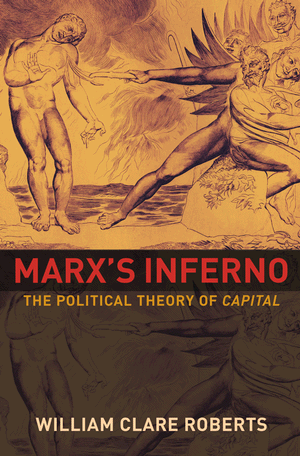
There’s a lot of confusion about these issues generally. Marxists and anti-Marxists alike have claimed that Marx’s perspective, according to which “ the evolution of the economic formation of society is viewed as a process of natural history,” implies the elimination of free will or individual agency. I think it does not. As I wrote in in my book on Capital, Marx’s Inferno:

Marx does not argue that economic relations manipulate individuals like puppets, but that economic relations dominate their decision making. Commodity producers in a commercial society face competitive pressures from other producers. These competitive pressures predictably incentivize certain courses of actions. Moreover, competition replaces producers who are insufficiently susceptible to those incentives with producers more susceptible to them. Under these conditions, producers – regardless of their personal idiosyncrasies or perfect-world preferences – will tend to act on market incentives, and to be price sensitive in their decision making. Their agency remains intact. They continue to make decisions based on their beliefs and desires, and to have all the characteristics attributed to persons by the standard accounts of agency. But they are not, for all that, fit to be held responsible for their actions in view of the market. They are not forced to act as they do, but they are subject to a kind of hazard that rules out discursive deliberation except within arbitrarily narrow parameters. (p. 96)

The question of determinism is whether prior causes compel human action, or whether, on the contrary, humans are able to choose from among courses of action. Denying determinism does not require denying the causal order or the explicability of human action; rather, it requires only the denial that causation implies compulsion. The issue is complicated in Marx because – like many of his major influences, such as Adam Smith and Hegel – his social theory is centrally an exploration of the unintended outcomes of intentional action, or the various ways in which the action of human beings is transmuted, by macro-social processes of aggregation, into scenarios in which it doesn’t seem to matter what any individual does. Smith and Hegel tended to focus on the positive outcomes of these scenarios – this is Smith’s invisible hand and Hegel’s cunning of reason. Marx was more interested in the negative outcomes – the negative externalities of economies centered on a market in labour-power. 

Neither of these perspectives imply determinism, however. And neither does Marx’s faith in the inevitably of socialism. As G.A. Cohen put it, Marx believed socialism was inevitable, not no matter what people did, but precisely because the proletariat had good reasons to bring it about and would, being rationally concerned with their well-being and the well-being of future generations, figure out how to bing it about. Human agency is what makes socialism inevitable, and so the inevitability of socialism cannot deny human agency. 

The question of positivism is a bit different. Positivism in the social sciences is the doctrine a) that the methods and modes of inquiry appropriate to the natural sciences are also appropriate to the social sciences, b) that the goal of all science is causal explanation and prediction, and c) that there is a fundamental distinction between science and everyday cognition or “common sense.” All of these elements of positivism can be given more or less strict constructions – so you might think that only experimental methods can arrive at scientific knowledge, or you might think that a wide range of empirical methodologies are adequate to the task. 

Marx certainly adheres to the third element of the positivist program: he constantly reiterates that, if simple observation of the apparent surface of the world were adequate for knowledge, no science would be possible. Science always penetrates the appearances of things in order to reveal the true order, which both differs from and explains how things appear. This is true of astronomy and it is true of political economy. 

In a sense, Marx also adheres to the second element of the positivist program: explaining and predicting the course of events is certainly Marx’s interest. However, this is complicated by what I said above. Marx thinks human beings act in more-or-less predictable ways, but this is predicated on them seeing and understanding their rational interests in a certain way, which cannot be taken for granted. The intelligent political action of a few can change how a huge multitude see their interests, and scientific works can do the same. Since Marx’s aim in writing and publishing Capital was to have just such an effect as this – to change how the working class movement saw its situation and ints interests – there is a fundamental tension between Marx’s project and positivism. 

But it is regarding to the first element of the positivist program that Marx most obviously diverges: he denes that the same methods and modes of inquiry are appropriate to scientific inquiry into the natural and the social world. One of his most famous invocations of science indicates this quite clearly. In the preface to the first edition of Capital, Marx writes, by way of a caution to the reader: 

Every beginning is difficult, holds in all sciences. To understand the first chapter, especially the section that contains the analysis of commodities, will, therefore, present the greatest difficulty. That which concerns more especially the analysis of the substance of value and the magnitude of value, I have, as much as it was possible, popularised. The value-form, whose fully developed shape is the money-form, is very elementary and simple. Nevertheless, the human mind has for more than 2,000 years sought in vain to get to the bottom of it all, whilst on the other hand, to the successful analysis of much more composite and complex forms, there has been at least an approximation. Why? Because the body, as an organic whole, is more easy of study than are the cells of that body. In the analysis of economic forms, moreover, neither microscopes nor chemical reagents are of use. The force of abstraction must replace both. But in bourgeois society, the commodity-form of the product of labour — or value-form of the commodity — is the economic cell-form. To the superficial observer, the analysis of these forms seems to turn upon minutiae. It does in fact deal with minutiae, but they are of the same order as those dealt with in microscopic anatomy.

The lines I have emphasized indicate why it is misleading to assimilate Marx’s project to positivism. The methods he advocates and uses are essentially and necessarily different from the methods of the natural sciences. Experimentation and the isolation and observation of empirically identifiable objects and events are, according to Marx, inappropriate to the task of scientifically understanding the laws of motion of capitalist production. 

For all of these reasons, I think that Ganz is incorrect – or only superficially and partially correct – in his treatment of Marx. Marx was not a determinist about history, nor was he a productive forces determinist about socialism. He was not a positivist. 

Nonetheless, I think Ganz is exactly right that Marx’s emphasis on scientific inquiry, his denigration of the effectiveness of moral transformation, and his hard-nosed insistance that socialism has material prerequisites do indeed mark out “what is so radical, strange and distinctive about Marx as a thinker, what it is that makes him still fun to read and compelling in the 21st century.” I think he is right that there is a real resistance and even embarrassment among many on the Left, including on the socialist and communist Left, about these aspects of Marx’s work. 

However, I think this resistance and embarrassment stem, at least in part, from the very conflations – of science with positivism, explanation with determinism, and the material prerequisites of socialism with accelerationist faith in the autonomy of productivity – of which Ganz’s provocation is guilty. 

Friday, May 24, 2019

On “Doing better in arguments about sex, gender, and trans rights”


This is a response to the essay published on Medium yesterday by Sophie Allen, Jane Clare Jones, Holly Lawford-Smith, Mary Leng, Rebecca Reilly-Cooper, and Kathleen Stock.

I probably shouldn’t do this, but… The authors claim that they want to have a good faith conversation. And a number of people who I know, or know of, and who I respect or take seriously are linking to this and taking that claim at face value. For the sake of those people, and other people of good faith who don’t know what to make of the very loud and very sharp arguments about trans rights, I think it might be worth saying something.

I am not a woman. I am not trans. I am a feminist – my earliest conversion experience was reading Andrea Dworkin and Catharine MacKinnon. I love very dearly a little trans girl who I hope grows up in a world where she is safe and free, or at least has a righteous and fierce community of people fighting at her side for safety and freedom. 

My response follows the authors’ essay point for point, for the most part, but it gets away from me a bit at the end. Anyway, I hope this is helpful for someone besides me.

Section one: fallacious arguments
1. ‘Your position has been historically associated with far right-wing thought, and hence fails’.
The authors write: “Associating our intellectual position with a far right-wing one, because some far right-wing thinkers would agree with us in some of our conclusions, and insinuating that our position is all the worse because of it, is an ad hominem. Ad hominems are widely recognised as inappropriate in philosophy.”

Political arguments are different from purely philosophical arguments. The fact that one group of political advocates makes the same, or similar, arguments as another – politically dangerous and loathsome – group is not irrelevant to the political assessment of those arguments. It is true that “the fact that person shares a conclusion with a far right-wing person could never show, on its own, that the conclusion was false.” However, when people claim “that women, by definition, are adult human females,” and conclude, on this basis, that “no trans woman is correctly categorised as a woman,” this is not like happening to agree with a far right wing person about what day of the week it is.

The “gender critical” position is a reactionary political position – in the sense that it is a “backlash” position, reacting to trans people’s progress towards social and political liberation – which politically aligns with the efforts of the far-right to naturalize social differences and make outcast groups more vulnerable to physical and economic harm. No doubt most, if not all, “gender critical feminists” regard themselves as being on the left, and find it disconcerting at the least to be accused of holding a reactionary position. But this has happened before. When radical feminists, in the ‘80s, made common cause with the Christian Right in the US to attack pornography and the sex trade, they were rightly criticized for taking a reactionary position, a position that hurt women – especially the most vulnerable women – more than it helped. The same goes for the current “gender critical” backlash against trans women: some left feminists are taking a bad position out of a misguided and mistaken belief that, in order to protect cis women from sexual violence, they have to police the bodies and movement of trans women.

2. ‘You are biological essentialists’
According to the authors, to call the “gender critical” view “‘biological essentialism’ is a misnomer. Moreover, it is a misnomer apparently rhetorically designed to draw some of the harsh criticism which appears in progressive circles about biological essentialism, in the true sense, onto the view that women, definitionally, are adult human females.”

Frankly, I don’t understand what this rejoinder is trying to accomplish. If the “gender critical” position is that all and only women are adult human females, and if “female” is supposed to denote a set (or cluster) of biological traits, then why doesn’t it follow that “womanhood” is “biologically produced”? The “gender critical” position is that to be a woman is to be a member of a biological sex category. To call this position “biologically essentialist” is not a “misnomer,” and it is certainly not a “fallacy.” Calling the position biologically essentialist does not mean it is wrong, of course! The critics of the “gender critical” position disagree that “womanhood” is a matter of biology alone, and calling the “gender critical” position biologically essentialist signals this disagreement, but is not yet an argument for the social (co-) determination of  womanhood. The authors call their position “realism about biological sex categories”; the critics call it “biological essentialism.” The authors’ preferred term implies that social constructivism about womanhood is a form of anti-realism. This is no more or less a “fallacy” than calling their realism “essentialist.” These are disagreements, not fallacies!

3. ‘You want to reduce women to their genitalia, or to womb-possession’.
“None of us,” the authors maintain, “hold a view according to which either a woman or a female is defined as such by her current possession of a particular configuration of genitalia, womb, or any other single primary sex characteristic, for that matter. … In the light of this, the correct question should be, not ‘Do we ‘reduce’ women to their genitalia, or wombs?’ but ‘Do we ‘reduce’ women to a cluster of primary sex characteristics?’”

I disagree. The real question is actually this: how do we police women? When and how do we – in our social and political arrangements and institutions – stop people and ask them if they are “really” women or not? The authors are concerned to keep (some) people who claim to be women out of (some) “women only” spaces and institutions. In practice, that means looking in people’s underpants. It means empowering the police, social workers, volunteers, and people on the street to demand to know what is between other people’s legs. That is what the critics of the “gender critical” position are practically concerned about when they say that “gender critical” feminists “reduce women to their genitalia.” They are concerned that, to the extent that the “gender critical” feminists get their way, people who claim to be women will be asked – in order to access social services and facilities – to prove it by displaying their genitals to someone or another.

4. ‘You think there is a “right way” to be, as a woman/ lesbian/ mother’ (etc.).
The authors think that this objection “trades on an ambiguity between two separate senses of the word ‘right’: normatively right versus descriptively right (i.e. descriptively correct). As such, it’s another rhetorical move. It can quickly and unfairly bring to the reader’s mind a metaphor of our gatekeeping for a special club — ‘you can come in, but not you!’.”

The “gender critical” feminists object, “To say that we think there is a definition of femaleness or womanhood is not to say that there is a ‘right way’ for females or women to be, in any normative sense.” Ah, but it is to say that there are people who shouldn’t call themselves women, and that the police should be able to check your papers (or your genitals) to see whether or not you are authorized to call yourself a woman. The “gender critical” definition of womanhood is normative in this sense: it is political and enforceable. It is, indeed, gatekeeping, and it does say, precisely, “you can come in, but not you!”

5. ‘You are transphobic’; or ‘You may not be transphobic but your views are’.
The authors want you to know that their views are not motivated by “an attitude of disgust, fear, or revulsion towards trans people because they are trans people,” and that their trans friends agree with them – and not “for self-hating reasons.” I’m happy to accept their report of their own – and their friends’ – introspection. I would ask, in return, that when someone tells them that they are a woman or a girl, the authors would accept this self-report and not call the police to check on the status of their genitalia.

6. ‘You think all or most trans women are violent against cis women’.
“This is a straw man,” the authors claim, “and none of us have ever said this, or think it’s true.” Rather, the authors are worried about what might happen, (1) “in a culture where it becomes increasingly widely known that sex-self-ID (with or without a Gender Recognition Certificate), rather than birth sex, is the determiner of entry/ lack of entry for biological males into woman-only spaces where females undress or sleep, and so are particularly vulnerable.” They are also worried about (2) “those who, we predict, would socially transition opportunistically for sinister motives, if the proposed changes to the UK Gender Recognition Act were to go ahead.”

This is the real nub of the issue, I think.

The authors – and I am willing to believe them on this – are not worried about trans women per se, but about opportunistic and predatory men. They are worried that opportunistic and predatory men will take advantage of a culture in which we believe people when they say they are women, and use that trust to harm and abuse women and children.

When stated this way, I think this concern is reasonable. All social institutions and norms are susceptible to opportunistic abuse, and it is worth our while to think about how any reconfiguration of social institutions and norms might be abused by the unscrupulous.

However, mutatis mutandis, the same scrutiny should be applied to our current social institutions and norms, the ones trans activists and organizers want to change. And this is where, I think, the limits of the “gender critical” position become stark. The authors simply show no awareness of how the current regime of gender policing harms trans and gender creative people, or how gender policing itself exposes women and children – including trans women and children – to predatory violence. And because they do not express any sympathy or understanding for what trans people are going through – the harassment, abuse, mockery, and violence they are trying to protect themselves from – the authors end up giving the impression – against their beliefs and intentions – that trans women are dangerous to cis women.

I accept that the authors do not think all or most trans women are violent towards cis women, but they manifestly do think that trans women are a vector for the endangerment of cis women. The authors think that if we start believing women when they say they are women – if we stop policing self-reported womanhood, stop asking for proof – then cis women will be at greater risk of sexual violence. The women who say “believe me when I say I am a woman” are dangerous to women: that is the “gender critical” position. And the authors have not at all grappled with – or even realized – the fact that this position is reasonably taken to be deeply offensive to trans people, and is a barrier to working with trans people on solving the common problem of how to make people safe and secure and free.

7. ‘No true trans woman is ever violent’ (See also: ‘No detransitioned person was ever really trans’)
I have never seen an example of this argument, so I am not sure what the authors are actually responding to.

8. ‘Women get attacked and aggressed in women-only spaces anyway’.
All people have an interest in being safe from physical and sexual assault. There are ways of making women-only spaces safe that do not rely upon policing people’s genitals. Moreover, an overall assessment of how safe women-only spaces are should include the safety of those excluded by a policing regime as well as those admitted.

9. ‘Why don’t you want to exclude lesbians from women-only spaces too?’
The authors get into trouble here for a couple reasons. First, they claim that “We aren’t arguing for the exclusion of lesbians from women-only spaces, because as far as we know, there is no documented statistical pattern of lesbian violence or aggression towards other females, whereas there is such a documented pattern of male violence.” This implies that there is “documented statistical pattern” of trans women violence or aggression towards other women. There is no such documented pattern, and asserting that there is would cause problems for the authors’ denial, above, that they think all or most trans women are violent against cis women. The authors could reply that statistically elevated risk does not imply that all or most trans women are violent. But it won’t do to justify a categorical regime of gender policing on the basis of a statistical risk – this is why racial profiling schemes are not only evil but also counterproductive. Sam Harris embarrassed himself repeatedly arguing for profiling observant Muslims after 9/11. Profiling doesn’t work.

Second, the authors also claim that “‘lesbian-free spaces’ would be impractical as an imposed social norm, since there’s no even roughly reliable way of visually identifying lesbians and differentiating them from non-lesbians. In contrast, we do have a rough-and-ready way of visually identifying males in women-only spaces. It isn’t perfect, and will regrettably cause misgendering in some cases; but no such system could be perfect, and we consider something as better than nothing.” This is simply begging the question. The critics of the “gender critical” position are arguing that the harm caused by not believing people when they say they are women is not merely regrettable but horrendous, and that letting people go to the bathroom or changing room where they are most comfortable would be significantly better than what we do now. That is, they are denying that the “something” we have is “better than nothing” – or, rather, they are denying that “nothing” is the relevant alternative.

10. ‘You need to understand why trans women are angry with you’.
I actually cannot bring myself to dignify this set of remarks – which are solipsistic and condescending in equal measure – with a response. Sorry.

11. ‘You are making violence to trans people more likely by your writing’.
12. ‘Trans rights are not like a pie; no-one gets less pie if trans people have rights’.
These points go together. The authors claim to “recognise two sets of rights and interests, those of trans women and women,” and to be “determined to foster a public conversation which takes both into account.” They treat these interests as if there were simply a zero-sum trade-off between them, however: “we do think that giving the social and/or legal capacity to male-bodied people to self-identify into woman-only spaces and resources, will take something substantial away from women, given a wider context of misogyny in society. That is precisely our point.” And they show no willingness to trade the interests of cis women for the interests of trans women: “We therefore request that society finds some other, better route to realising trans rights, compatible with realising the rights of women to lives free of harm.” I’m not sure, then, how this is supposed to foster a public conversation.

13. ‘Feminists have already had the discussion without you, and established that trans women are women’
The authors refuse to “defer to” recent feminist scholarship. That is their right. I think the objection, however, is that they do not try to engage with it or to understand what motivates it. More on this below.

Section two: bad analogies
1. ‘In the past, some people used to think black women weren’t real women. These days, some people now think that trans women aren’t real women. But black women are women, and so are trans women’.
2. ‘Excluding trans women from women-only spaces is like excluding black people from whites-only spaces’.
3. ‘Excluding trans women from women-only spaces is like excluding refugees or immigrants from the UK’.
4.‘ Trans women stand to women as adoptive parents stand to parents’.
5. ‘Arguing that you can’t be both a trans woman and a lesbian resembles the historical claim that you can’t be both a real woman and a lesbian’.
The arguments presented by the authors here cluster around three sets of claims. First, the authors claim that trans women’s full moral personhood is not denied them – either by society at large or, at least, by the “gender critical” position. Second, the authors deny that the position of trans women is one of special vulnerability (at least vis-à-vis cis women). Third, the authors reassert that theirs is not a normative definition of womanhood, but a purely descriptive definition. I will take these in turn.

(1) Moral personhood: One of the most persistent theoretical complaints I have seen about the “gender critical” position is that it operates with an incredibly simplistic and inadequate notion of oppression. This complaint seems to be substantiated by these sections of this essay. The reader is told that, during the era of New World slavery, black women were denied the status of “womanhood” insofar as “black women weren’t the sort of female white people should be interested in, or care about, or value. That is, it was a move which denied black women full moral personhood in the eyes of white people, and positioned them as undeserving of human rights.” After the end of slavery, “black people were historically subject to segregation because white people denied their full and equal humanity.”

But, the authors assure us, the “gender critical” position is not “that trans women don’t have full moral personhood. We emphatically and repeatedly assert that they do, emphasising their full human rights.” “The question is not whether they are human,” the authors continue, “but whether they are female, and on the basis of being female should be able to access spaces designed to protect the comparatively greater vulnerability of female people.” “No one thinks a man is denied his full and equal humanity merely because women-only spaces exist, and the same reasoning applies to trans women. Not giving people everything that they desire is not a denial of their humanity.”

Wow. I don’t think the authors have thought through what having your full and equal humanity denied might actually look like. It doesn’t, generally, mean that people deny that you are actually human. That does happen, of course, especially in rhetorical or polemical forms. But slaveowners never doubted for a second that black women were human – otherwise they would not have raped them systematically in order to breed more slaves. Enslaved black women could very well be the daughters and granddaughters of their masters. Their masters knew well enough that they were dealing with human beings. Nonetheless, “black women weren’t the sort of female white people should be interested in, or care about, or value.” Their wants, their desires, their interests didn’t count for anything in white people’s eyes. And nor did they count for anything in the eyes of the law.

“Not giving people everything that they desire is not a denial of their humanity.” True. But not taking people’s desires seriously, discounting what they say they need, dismissing their self-reports about what is most important to them – that is exactly what denying people’s humanity has looked like historically.

(2) Social positioning: The authors have a fall-back position, though:
Second, racial segregation was an exercise of power by a culturally dominant group against a culturally subordinated group. The dominant used their power to keep the subordinate out. Women are not a culturally dominant group; rather, they are a culturally subordinated group. When they act to maintain women-only spaces, we judge that they act to maintain protections that are important in light of their status. At best, trans women are a distinct subordinated group; at worst, trans women are members of the dominant group. At best, exclusion is a lateral move; at worst, it is an ‘upwards’ move. In neither case is it a ‘downwards’ move, and so in neither case is it comparable to racial segregation.

The authors use the same sort of argument to dismiss the analogy between the exclusion of trans women and the exclusion of refugees and migrants. They shouldn’t, because it is a very bad argument. They are, of course, right that racial segregation – and the xenophobic exclusion of migrants – are exercises of power by a dominant group. But notice that some of the people doing the segregating and border-closing are women (members of a subordinate group) and some of the people being segregated and excluded are men (members of a dominant group). Notice, also, that some of the folks in Britain (and the US) most supportive of a harshly exclusive immigration regime are poor and working class folks, and that some of the most virulent and violent opposition to integration in the US came from poor and working class folks. Just because you are a member of a subordinated group doesn’t mean you don’t have anything to lose – or anything you think you might lose if you don’t jealously guard it against newcomers.

Anyone who doesn’t realize this, I submit, hasn’t thought very much about how systems of social power work, or about how they cut across and complicate one another. There is even a bog-standard keyword of recent feminist research that names this incredibly common phenomenon. You know the one.

Anyway, for our authors to deny that trans people – especially trans women, and especially poor trans women and trans women of color – are “desperately vulnerable, and seek to access better life chances,” for them to deny that many trans people are desperate to pass – and go to great lengths to “exaggerate” their femininity or masculinity in order to avoid being “clocked” as trans – in order to avoid street harassment, assault, and worse, for them to deny that having a bathroom or a locker-room where you “belong” and where you are safe from harassment is a valuable “privilege” – well, yeah, that looks pretty “callous.”

(3) Pure description: Finally, the authors are at pains to impress upon us that “Our claim is a descriptive claim about category membership. It isn’t the claim that trans women don’t match some stereotypical sociocultural norms of womanhood.” Hence, also, “our arguing that a person can’t be both a trans woman and a lesbian is not done on the basis of our covertly assenting to some norm or stereotype about womanhood. Rather, our argument that a person can’t be both a trans woman and a lesbian is grounded in a claim about descriptive conditions upon the category of lesbians.” They’re just describing the world, okay?

In response to the suggestion that “trans women stand to women as adoptive parents stand to parents,” the authors respond that this “begs the question against the gender critical position.”
Both adoptive parents and biological parents have in common that they actually have — or have had — children that they parent. To accept that trans women are to natal women as adoptive parents are to biological parents suggests then that there is something essential to womanhood that they both share. But this is precisely what is at issue between us and our critics, so that the analogy settles nothing on its own.
But I think we haves seen that there may be something “essential to womanhood” that both trans and cis women – even “gender critical” women – do share – and I think the authors have shown us this. It is the conjoint desire to belong to the category “woman” and to escape from the terrible burden of belonging to that name. This is what Marilyn Frye calls “the double bind.” I am not a woman. I am not trans. I am not speaking from any experience of my own. But I have studied and learned from and loved and listened to women and trans people, and I think I see a pattern. When a person calls herself a woman, and wants to be seen as a woman, and yet fears the social punishment that comes with being a woman, and rails against the limits imposed on women – I think that person is a woman. And I think we should both treat her as a woman and not treat her as a woman, because women aren’t treated well, and the only thing worse than being treated as a woman might be being treated as not quite a woman, or a failed woman. And if the authors can’t see that, well… I’m sorry, but I don’t think they are going to contribute to “more fruitful discussion from now on.”